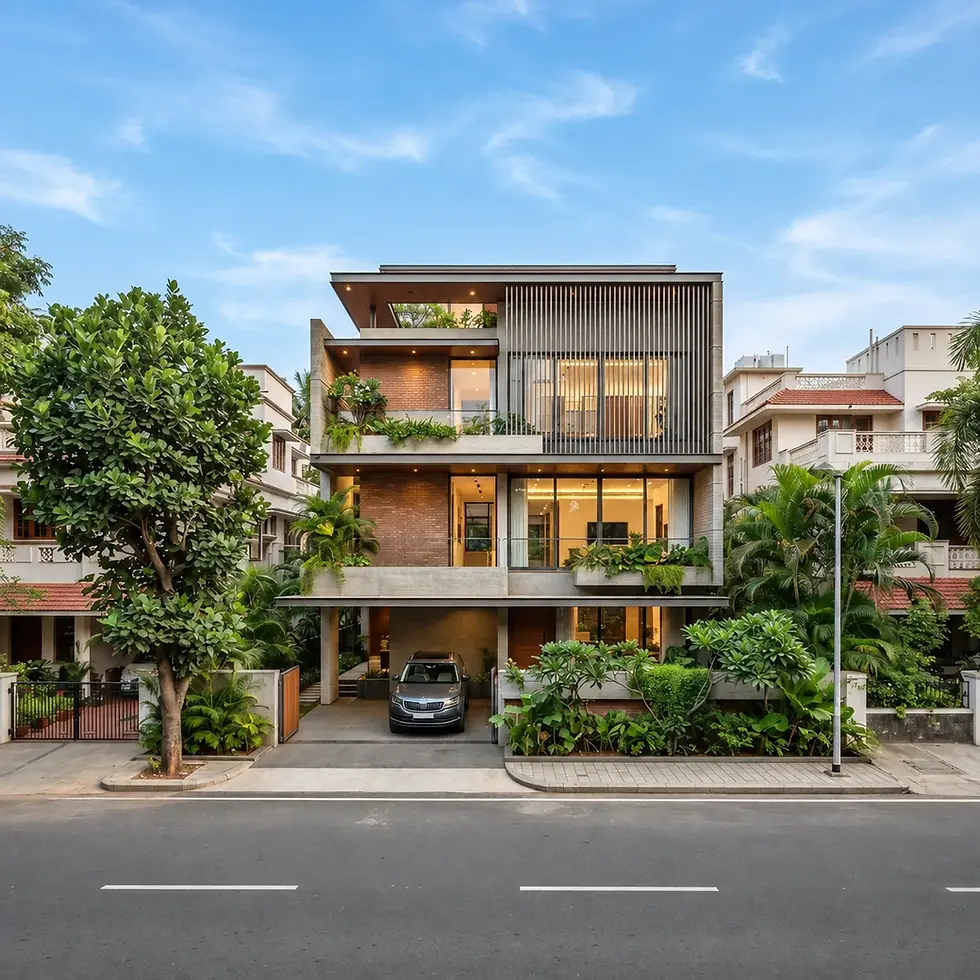
Hiring an Interior Designer in Koramangala? What Should Your Home Interior Contract Include Before You Sign?


You've seen the 3D views, liked the mood board and agreed on a budget. Now the designer sends a contract and asks for a booking amount. This is the moment most homeowners rush, and it's the moment that matters most. A clear interior design contract checklist protects you far more than any render, because it decides what happens when something goes wrong.
Here's the short answer. Before you sign, your home interior contract should include five things in writing:
An itemized BOQ with materials, brands, sizes and rates for every item
A payment schedule tied to work completed, not to dates
A handover date with a delay penalty
A warranty and a snag-fixing period, with a small final payment held back until snags are closed
Society compliance responsibilities: who handles permissions, deposits, work hours and debris
The rest of this guide explains each one, with a focus on Koramangala apartments and homes.
Why the Contract Matters More Than the Design
Most interior disputes in Bangalore aren't about taste. They're about money and time: extra charges that weren't discussed, work that stalls after a large advance, and finishes that don't match what was promised.
Consumer complaint forums and legal Q&A sites show the same patterns again and again:
Advances paid before a signed contract was shared
Requests for more money with no invoice or progress to show for it
Completion dates promised verbally but never written down
Payments made to a personal account instead of the company
All of these are avoidable with a proper written agreement. Under the Indian Contract Act, what's written usually carries more weight than what was said in a meeting, so get every promise on paper.
If you're still choosing between firms, our guide on how to choose the right interior designer in Bangalore covers shortlisting and red flags before you get to the contract stage.
Design-Only or Turnkey: Know What You're Signing For
Your contract looks very different depending on how you hire.
Design-Only | Turnkey (Design + Execution) | |
What you pay for | Drawings, 3D views, specifications | Design, materials, labour and site management |
Who manages workers | You or your contractor | The interior firm |
Contract focus | Deliverables, revisions, design fee | BOQ, payments, timeline, warranty |
Your risk | Gaps between designer and contractor | Depends on how tight the contract is |
Best for | Owners with a trusted contractor | Busy owners who want one point of contact |
For most Koramangala apartments, turnkey is the practical choice, especially if you work full time or live away from the site. But turnkey only works in your favour if the contract is detailed.
The Interior Design Contract Checklist
Use this as your home interior agreement checklist. Each point should appear in the signed document.
Party details: full names, addresses, company PAN and GSTIN of the interior firm.
Site address and scope: every room included, and anything explicitly excluded.
Drawings and BOQ as annexures: the final approved drawings and the BOQ attached to the contract.
Design revisions: how many revision rounds are included before extra fees apply.
Payment schedule: stages, percentages and what must be completed before each payment.
Timeline: start date, design sign-off date, handover date.
Delay penalty: what the firm pays if handover slips, and what counts as a valid extension.
Change orders: any change after sign-off is priced and approved in writing before work starts.
Warranty: separate terms for workmanship, hardware and appliances.
Snag list and retention: how snags are recorded and fixed, and how much payment is held back until they are.
Society compliance: who arranges permissions, deposits and worker passes.
Termination and refunds: what happens to your money if either side exits.
Dispute resolution: how disagreements are settled, and where.
Payment method: all payments to the company account, with a GST invoice or receipt for each one.
For the format, a home interior agreement in India is usually a signed written contract, ideally on stamp paper as required under the Karnataka Stamp Act, with the BOQ, drawings and payment schedule attached as annexures. If the firm only offers a one-page quotation, ask for a proper agreement before paying anything beyond a small booking amount.
What Should Be Included in an Interior Design Bill of Quantities (BOQ)?
The BOQ is the heart of your contract. It's an itemised list of everything the firm will make, supply or install, with quantities and rates. A vague BOQ is where hidden costs live.
Line items a good BOQ must have
BOQ field | What to look for | Red flag |
Item description | "Master bedroom wardrobe, sliding, 8 ft x 7 ft" | "Wardrobe – 1 no." |
Core material | Board type and grade, e.g. BWP plywood or HDHMR | "Ply" with no grade |
Finish | Laminate, acrylic, veneer or PU, with brand and thickness | "Premium finish" |
Hardware | Brand and type of hinges, channels and handles | "Branded hardware" |
Quantity and unit | Sq ft, running ft or number | Lump sum only |
Rate | Per unit rate | Only a total per room |
Inclusions | Installation, transport, debris removal | Not mentioned |
Items that are often missing
Check whether these are in the BOQ, excluded, or listed as "extra at actuals":
Civil work: wall breaking, tiling, waterproofing
Electrical: new points, wiring, lights and fittings
False ceiling: gypsum ceiling, cove lighting, profile lights
Painting: walls and ceilings, number of coats
Plumbing: sink, taps, kitchen connections
Appliances: hob, chimney, built-in oven
Loose furniture and soft furnishings: sofas, curtains, blinds
GST: interior works contracts are generally charged 18% GST. Check whether the total includes it
What does it cost in Koramangala?
As a planning guide, Cohere's current price bands for Koramangala homes are:
Home type | Typical interior budget |
3BHK homes and duplexes | ₹12–22 lakh |
Premium 3BHK and 4BHK | ₹22–35 lakh |
Independent villas | ₹35–75 lakh+ |
Your final figure depends on materials, scope and the condition of the apartment. For per-sq-ft rates and a full breakdown of hidden charges, see our interior design cost breakdown for Bangalore and Koramangala.
Planning Your Home Interiors in Koramangala?
Get a clear understanding of your interior design scope, materials and budget before starting your project.
How to Structure Interior Design Payment Milestones & Delay Penalties
A fair interior design payment milestones schedule
There's no single standard in Bangalore. Organized firms commonly ask for a booking amount of around 5–10%, then link the rest to design sign-off and site progress. A large advance with nothing delivered is the most common trigger for disputes.
Here's a balanced structure to use as a starting point in negotiation:
Milestone | What must be complete | Payment |
1. Booking | Signed contract, site measurement | 5–10% |
2. Design sign-off | Final drawings, 3D views and BOQ approved | 30–40% |
3. Material dispatch / factory production | Production started, photos shared | 25–30% |
4. Installation complete | All items installed on site | 15–20% |
5. Handover and snags closed | Snag list cleared, warranties handed over | 5–10% |
Two rules matter more than the exact percentages:
Never pay ahead of work. Each payment should follow a visible, checkable milestone.
Hold back the last 5–10% until the snag list is closed and you've lived with the work for a few days.
Writing delay penalties that actually work
A delay clause is only useful if it's specific. Include:
A handover date, not "approximately 45–60 days"
A grace period, for example one or two weeks
A fixed penalty per week of delay after the grace period, either a flat amount or a small percentage of the contract value
A cap on the total penalty, so the clause stays enforceable
Valid extension reasons, such as your own design changes, society restrictions or delays in your decisions
Delays are rarely one-sided. Late decisions from homeowners and society restrictions cause as many problems as slow vendors. Our guide to why interior design work gets delayed explains the most common causes and how to plan around them.
Koramangala Apartment Interior Guidelines & Society Compliance Rules
Koramangala has a mix of older apartment buildings, newer gated complexes, independent houses and duplexes. In an apartment, your society or owners' association has a real say in how interior work is carried out.
The legal background
Apartment complexes in Karnataka are governed mainly by the Karnataka Apartment Ownership Act, 1972, along with each building's registered declaration and bye-laws. Associations can regulate renovation work to protect common areas and other residents. The Act also says owners must not carry out work that would affect the soundness or safety of the building.
A new Karnataka Apartment (Ownership and Management) Bill has been proposed to replace the 1972 Act, but at the time of writing it has not come into force. Check your association's current bye-laws before work starts.
Common society rules to plan for
Every association sets its own rules. Most cover:
Written intimation or NOC before interior work begins
Work hours, often with restrictions on Sundays and public holidays
A security deposit for possible damage to lifts, corridors or common areas, usually refundable
Lift use and protection during material movement
Debris removal at the owner's or contractor's cost, not into common bins
Worker ID and registration with building security
No structural changes: no breaking load-bearing walls, columns or beams
External changes, such as balcony enclosures, grills or facade changes, which usually need approval
If the association asks for a non-refundable charge on top of a deposit, ask which bye-law allows it. Associations should be able to explain the basis for any fee.
What your contract should say about society compliance
Add a clause that makes clear:
Who applies for the society NOC and worker passes
Who pays any deposits, and who is responsible if they're forfeited
That the firm will follow the society's work hours and debris rules
That delays caused by society restrictions are recorded, and whether they extend the timeline
This avoids the familiar argument where the firm blames the society and the society blames the firm.
Real Projects: What a Clear Scope Looks Like in Practice
These are completed and ongoing apartment projects from Cohere's portfolio. They show how a defined scope and clear decisions keep projects predictable.
Ivory & Oak, Jayanagar: 2,000 sq ft turnkey apartment
A completed (2024) turnkey apartment interior built around natural wood and ivory tones. Turnkey projects like this one depend on a detailed BOQ, because one firm handles design, materials and execution. See the Ivory & Oak contemporary apartment interior project.

Subtle Splendor, Banashankari: 2,400 sq ft 4BHK
A completed (2024) 4BHK apartment interior with a project value of ₹40 lakh. The design focused on smooth flow between spaces with minimal changes to the existing structure, an approach that also keeps society approvals simple.

Solace Suite, Jayanagar: 1,800 sq ft turnkey apartment
A completed turnkey project using a restrained, minimalist palette. Fewer decorative elements meant fewer line items, which makes the BOQ easier to check and the budget easier to control.
Ready to Plan Your Home Interiors?
Discuss your requirements with Cohere's interior design team and get clarity on the design and execution process.
Frequently Asked Questions
1.How much advance should I pay an interior designer?
A booking amount of around 5–10% is common among organized firms. Avoid large advances before design sign-off, and link every later payment to visible progress on site.
2.Is a quotation enough, or do I need a formal agreement?
A quotation lists prices. An agreement sets out scope, timelines, payments, warranties, penalties and what happens if things go wrong. For a full home interior, insist on a signed agreement with the BOQ attached.
3.Is the booking amount refundable?
It depends entirely on your contract. Many firms treat it as non-refundable once design work starts. Get the refund terms in writing before you pay.
4.Should I pay an interior designer in cash?
No. Pay the company account by bank transfer or card, and get a GST invoice or receipt for each payment. It's your proof if there's ever a dispute.
5.What can I do if my interior designer delays the work?
First, rely on the delay clause in your contract and record everything in writing. If the issue isn't resolved, consumers can approach the National Consumer Helpline (1915) or file a complaint with the consumer commission.
6.Do I need my apartment association's permission for interiors?
Usually, yes. Most associations require written intimation, a refundable deposit and adherence to work-hour rules. Structural changes are generally not allowed.
Final Thoughts
A good interior design contract is specific, balanced and in writing. Insist on an itemized BOQ, milestone payments tied to real progress, a handover date with a delay penalty, a warranty with a retained final payment, and a clear plan for society compliance. With those in place, you can focus on the design instead of chasing the vendor.
Planning Interiors for Your Koramangala Home?
At Cohere, every project starts with a detailed, line-by-line written quotation, so you know exactly what you're paying for before you sign. Share your floor plan and requirements, and our team will walk you through the scope, BOQ and payment schedule for your home.