
NRI Home Interior Design in Bangalore: Managing a Project from Abroad

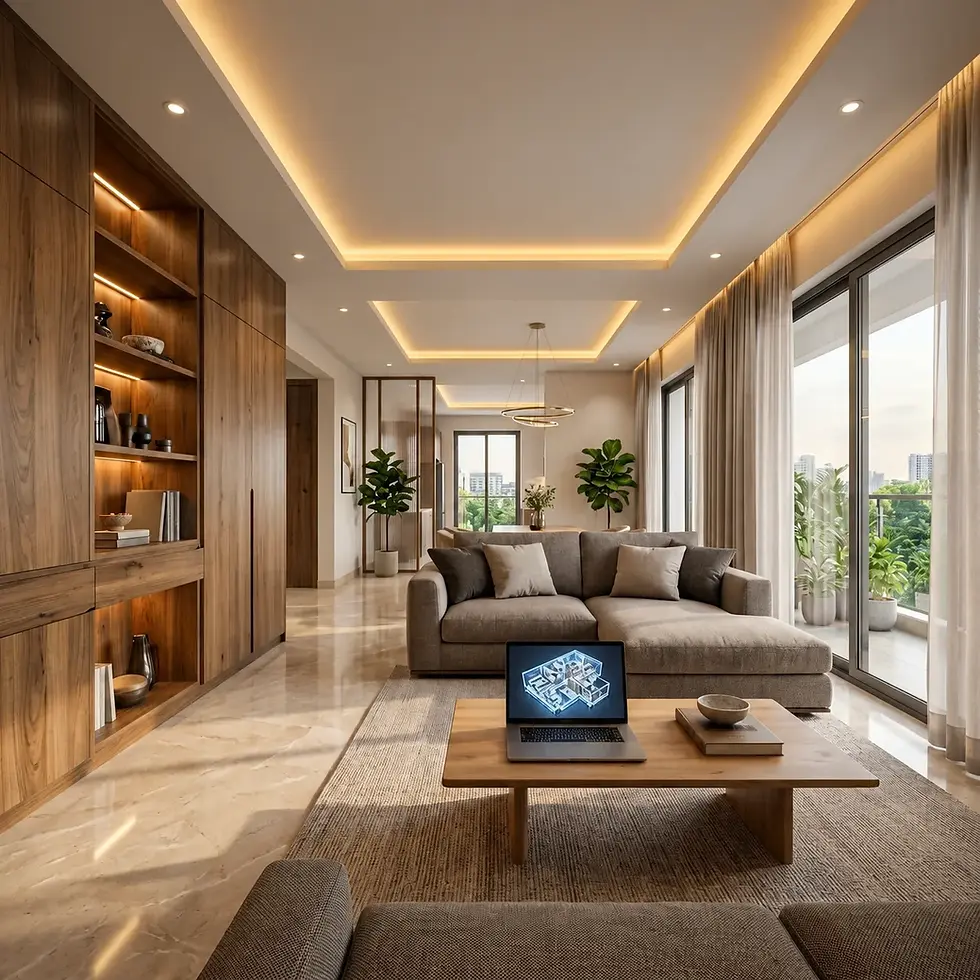
NRI home interior design in Bangalore can be managed almost entirely from abroad. Briefing, design review, material choices, approvals, payments and progress checks can all happen over video, shared files and written sign-offs. A few tasks still need people in Bangalore: measuring the site, dealing with the builder and the apartment society, and the final snag check.
The projects that go well are rarely the ones where the owner is online the most. They are the ones where every decision is written down, progress is visible, and one named person is responsible on site.
This guide is for owners who live outside India and want to manage a home interior project from abroad without losing control of it. It covers what can be done remotely, which decisions you will face and when, how to check work you cannot see, how to think about payments, and what to ask before you hire.
Can you manage home interiors in Bangalore from abroad?
Yes, with one condition. The studio you hire has to act as your eyes and hands in Bangalore, and you have to give clear decisions on time. Remote consultations, 3D visualizations, digital approvals and video walkthroughs make that practical. They do not replace a capable person on site every day.
What can be done remotely
● Briefing and design discussions by video
● Reviewing drawings and 3D visualisations
● Choosing materials and finishes using photos, samples shown on camera, or a relative’s help
● Approving scope and the quotation
● Paying in stages
● Reviewing weekly progress and a final video walkthrough
What still needs someone on the ground
Task | From abroad? | Notes |
Briefing, design reviews, 3D approvals | Yes | Video calls and shared files |
Material selection | Mostly | Daylight photos, samples shown on camera, couriered samples, or a relative checking in person |
Contract and stage payments | Yes | Signed agreement by email or e-signature; stage payments by bank transfer to Cohere’s company account |
Site measurement and documentation | No | Done on site by the studio team |
Builder handover inspection and key collection | Not directly | Needs the studio or an authorized representative. Ask a lawyer what authorization is appropriate |
Apartment society permissions | Not directly | Usually handled on site by the studio; you may need to supply documents |
Final quality check and snag list | Partly | The studio checks on site; you review by video |
Registration, Power of Attorney and other legal steps | Outside an interior studio’s scope | Speak to your lawyer |
If someone will collect keys or attend an inspection for you, ask a lawyer what written authorization is appropriate. A studio can tell you which tasks need a representative, but it cannot advise on legal paperwork.
What to have ready before you start
You don’t need everything on day one. The more you bring, the faster the first conversation moves.
● A floor plan or the builder’s drawings. Share what you have.
● Possession status or the expected date.
● Who will live there, and when: you and family, your parents, or tenants.
● A rough budget range, even if flexible.
● A local contact, such as a relative or friend who can open the door and look in occasionally.
● Preferences on style, storage, Vastu or anything else that matters to your family.
● Your best times for calls, in your own time zone.
Not sure how to frame a budget? Cohere’s free consultation includes a space assessment, design guidance and an indicative project cost estimate. For general preparation, our post on what we wish every Bangalore homeowner knew before starting interiors is a good companion.
How a remote interior design project works, step by step
A remote project follows the same stages as a local one. What changes is how each stage is communicated and recorded.
Step 1: Video consultation and site documentation
The first call covers your brief, budget, timeline and how involved you want to be. A site visit before design matters even more when you can’t be there yourself. It captures dimensions, natural light, existing conditions and electrical points, which the design depends on. At Cohere, a site visit before design is part of the process.
After the site visit, Cohere shares a measured drawing, a dated photo set and a walkthrough video of every room in a shared folder, so you see exactly what we see. Calls are scheduled inside your day where possible: mornings IST for Singapore and Australia, afternoons and evenings IST for the Gulf, UK and Europe, and early mornings or late evenings IST for North America.
Step 2: Design, 3D views and written sign-off
Drawings and 3D visualizations let you see rooms before anything is built. Cohere’s interior team prepares drawings and 3D visualizations as part of its design service.
Whatever studio you choose, ask for approvals to be recorded in writing, room by room, by email or in a shared document. A simple approval log saves arguments later.
At Cohere, each room’s drawings and 3D views are approved in writing, by email or in a shared approval sheet, with the date and the drawing version. Nothing goes to the workshop or the site without that sign-off.
Step 3: Choosing materials without touching samples
There are four workable ways to approve materials from abroad:
● Daylight photos of each sample, taken next to the proposed furniture or flooring
● Samples held up on a video call
● Couriered samples for the finishes that matter most
● A relative or friend in Bangalore who looks at samples in person
Ask for every material to be named in the quote by brand, grade and thickness. That way, what you approve is what gets ordered.
Cohere shortlists two or three options for each key finish and shows them to you in daylight photos and live on video. For finishes that are hard to judge on a screen, such as laminates, veneers and stone, we can courier sample chips to you, or keep a sample board ready for a family member to see at our Banashankari studio.
Step 4: Execution and site supervision
Cohere’s turnkey service covers planning through execution, including sourcing materials and overseeing the work, with regular updates throughout. Our interior team acts as a single point of contact for drawings, 3D visualizations, selections, supervision and quality checks.
Whoever you hire, ask who is on site each day, who coordinates the carpenters, electricians and plumbers, and how you will hear about a problem.
Every Cohere project has one named project lead as your point of contact, and a site supervisor who coordinates carpenters, electricians and plumbers each day. Remote clients get a written update with dated photos and short videos every week, by email or WhatsApp, plus a scheduled video call every week or fortnight.
For planning, see how long a 3BHK interior takes and what typically delays interior projects in Bangalore.
Step 5: Snagging, styling and handover
Before you arrive, the home should be checked room by room, with a written list of what is finished and what still needs correcting. Ask for a video walkthrough of the whole home, including inside cabinets and wardrobes.
Before handover, Cohere prepares a written snag list room by room and closes every item. The home is then deep-cleaned and styled, and you receive a full video walkthrough, including inside cabinets and wardrobes, along with warranty documents, care instructions and a named contact for aftercare.
The NRI decision calendar: what to approve, and when
Owners abroad are often asked for decisions at short notice. Knowing the order in advance lets you plan your own time. Order matters because changes are cheap on paper and costly once something has been built.
Stage | Decision you will be asked for | Why it matters |
Before design starts | Brief, budget range, must-haves, local contact | Everything else builds on it |
After site measurement | Layout, furniture plan, kitchen and wardrobe positions | Sets how each room works |
Before materials are ordered | Finishes, hardware, lighting | Orders are placed against these choices |
Before wiring and plumbing are closed | Positions of switches, sockets, data, AC and TV points | Hard to move once walls are closed |
Before joinery is made | Final dimensions and elevations | Cabinets are made to size |
During execution | Any change in scope, approved in writing with cost and time impact | Prevents surprises on the final invoice |
Before handover | Snag list, reviewed by video | Confirms finished work matches what you approved |
After handover | Aftercare contact and warranty documents | You know who to call |
This is an illustrative sequence. Ask your studio for its own decision schedule at the start.
Illustration (not a client story): suppose you approve a living room layout from a 3D view, but nobody confirms where the TV and AC points should go. The walls are closed with the points in default positions, and moving them later means opening finished work. A short, dated checklist before closure avoids this.
Cohere shares a project-specific decision schedule at kick-off, in this same order. For routine approvals we ask for a reply within three to five working days, so site work isn’t held up waiting for a decision.
How to check progress when you can’t visit the site
What a useful weekly update contains
● Work completed this week, compared with the plan
● Photos and short videos of each area worked on
● Photos of wiring and plumbing before they are closed up
● Work planned for next week
● Decisions needed from you, each with a deadline
● Any delay or problem, and its cause
● Pending variations and their cost
Photos and video that actually help
Ask for dated photos taken from the same vantage points each week, plus close-ups of details. Wide shots show progress; close-ups show workmanship.
Independent checks
For larger projects you may want someone independent of the studio to inspect at key stages. That could be a relative with building experience or a professional you appoint. Agree this in advance so the studio expects it.
Nominating a family member
A relative can do spot checks and receive deliveries. Keep decisions and approvals with you, so the studio never receives conflicting instructions.
Cohere sends this update every week. It is prepared by your project lead and shared as a short report, with photos and videos in a project folder you can open at any time.
Payments, milestones and contracts
Tie payments to visible progress
Stage-wise payments mean each instalment follows work you can verify. Ask for stages defined by what is finished, such as “cabinets installed”, rather than by calendar date alone.
Cohere’s payments follow the same principle: a booking amount when the agreement is signed, a payment when the final design is approved, then execution instalments linked to visible milestones, such as civil and electrical work complete, carcasses installed and final installation. A small balance is held until the snag list is closed.
What an itemized quote should name
● Scope, room by room
● Materials by brand, grade and thickness
● Hardware and fittings
● Finishes
● What is not included
● How variations are handled
● The timeline
● Warranty terms
NRE and NRO accounts and transfers
Many NRIs pay for work in India from NRE or NRO accounts. The rules on transfers and the tax position depend on your situation, so check with your bank or chartered accountant before you commit. The Reserve Bank of India publishes FAQs on NRE and NRO accounts. Its FAQ on accounts in India held by non-residents compares NRE and NRO accounts side by side.
Cohere accepts payment by bank transfer (NEFT, RTGS, IMPS or an international wire) to its company account, and issues an invoice for every installment. We never ask for payment to a personal account, and you shouldn’t accept that from any studio.
Changes priced in writing
A change should come with its cost and time impact in writing before work begins, and you should approve it. This protects both sides.
Costs
This guide doesn’t go deep on pricing. For planning, see how to allocate an end-to-end interior budget and our 4BHK villa interior cost breakdown. Our interior design page lists indicative ranges: 1BHK ₹3.5–8 lakhs, 2BHK ₹6–15 lakhs, 3BHK ₹12–25 lakhs, and independent villas ₹35–80 lakhs and above, depending on scope and finishes. These ranges apply to remote projects too. Managing your project from abroad doesn’t change Cohere’s design fee or scope; only extras you ask for, such as couriered samples, are quoted separately.
Working across time zones
Time zones are a communication problem, and they are easy to fix with a few agreements:
● Fix one weekly call. Use a time-zone converter to check the overlap. In countries that use daylight saving, it shifts twice a year.
● Use one messaging channel for quick questions between calls.
● Agree response times for routine and urgent matters.
● Send decisions as a list with deadlines, not as scattered messages.
● Batch your questions, so each call settles several things.
Cohere fixes one weekly call in a slot that suits your time zone, uses WhatsApp for quick questions, and uses email for approvals, quotes and anything that needs a record.
Handover from abroad: builder snags and society formalities
If your apartment is new, the builder’s handover and your interiors are linked. Defects the builder leaves behind should be recorded before interior work starts. Otherwise it becomes hard to tell whose work caused what.
Many apartment communities also have rules for interior work, such as permitted working hours, how materials may be moved, and lift protection. Ask your studio how it handles these, and what documents you may need to supply.
Also settle who will hold the keys, and who will be present at the builder’s inspection. If someone acts on your behalf, ask your lawyer about the right written authorization.
Questions about the builder’s obligations are separate from interiors. The Karnataka Real Estate Regulatory Authority publishes information for homebuyers. Complaints against a builder can also be filed through the same portal.
Our guide to 12 interior planning mistakes to avoid after possession covers the wider picture.
Cohere’s team can attend the builder’s handover inspection alongside your authorised representative, photograph and record builder defects before interior work starts, and handle the society’s interior-work application, deposit and working-hour rules for you. You may still need to sign the society’s forms.
Should you visit Bangalore during the project?
It isn’t required. Two points may be worth a visit if your schedule allows: design sign-off, when you can see the site’s real light and handle materials, and the final walkthrough at or before handover.
Decide based on the size of the project, your comfort with remote reviews, and your travel plans. If you can’t travel at all, ask the studio how it will cover those two points. Couriered samples, a longer video review, or a relative’s visit are all options.
Red flags when hiring an interior designer from abroad
Use these questions with any studio, including us.
What to ask | A good answer | A warning sign |
Who is my named point of contact? | One named person and how to reach them | “The team”, or a rotating queue |
Who is on site each day? | A named supervisor or a clear process | A vague answer |
How will I see progress? | A defined format and frequency | “Regular updates” with no detail |
How are approvals recorded? | In writing, per room or stage | Verbal only |
How are payments staged? | Tied to finished work | A large advance with no stage link |
What does the quote name? | Brands, grades, scope and exclusions | Lump-sum lines |
How are changes priced? | In writing, before work starts | Added at the end |
Can I speak to past clients who were abroad? | References where clients agree | The question is avoided |
What happens after handover? | A defined support period and contact | No answer |
We would rather you ask us these questions than not. Cohere’s answers: one named project lead; a site supervisor who coordinates the trades daily; a weekly photo and video report plus a scheduled call; approvals in writing for each room; payments tied to finished stages; an itemized quote naming brands, grades and exclusions; changes priced in writing before work starts; references from past clients on request; and a defined aftercare period with a named contact.
If you are choosing between design-only and full execution, our post on hiring an architect and interior designer together may also help.
NRI interior design for different situations
A new apartment after possession
The main risks are timing and handover logistics. Settle the decision calendar early, record builder snags first, and plan call times around the society’s working hours.
Villa interiors
Villas involve more rooms, more trades and more decisions. Cohere’s villa work includes a 7,000 sq ft villa in Sarjapur Road and a villa in Devanahalli. These show our style, though not necessarily remote projects. For more, see our guide to villa interior designers.
Renovating your parents’ home
If your parents live in the house, renovation is better done in phases, with safety, access and noise in mind. Cohere offers renovation and remodelling services. Cohere phases the work room by room, so a bedroom, a bathroom and the kitchen stay usable at every stage. Noisy work is kept to agreed hours, walkways stay clear, and work areas are sealed off to limit dust.
Rental-ready or second home
Cohere also designs homes meant for tenants or occasional stays. The focus is durable, easy-to-clean finishes, generous built-in storage and a neutral palette that suits most tenants, so the home rents well and needs little upkeep while you’re away.
How Cohere works with NRI clients
Cohere is a design studio in Bangalore founded by Ar. Madhupriya N. and Ar. Gagan B., both principal architects, with nearly two decades of collective experience. Our interior services include turnkey execution, drawings, 3D visualisations, selections, supervision and quality checks, with regular updates through the project. You can see our work on the portfolio page.
Planning your Bangalore home from abroad?
Start with a free consultation. Cohere’s consultation includes a space assessment, design guidance and an indicative cost estimate. Share your floor plan, possession date, a rough budget and your time zone, and we’ll take it from there.
Frequently asked questions
1.Can an NRI get home interiors done in Bangalore without coming to India?
Yes. Design discussions, 3D approvals, material choices, payments and progress checks can all be done online. A few tasks still need people in Bangalore: site measurement, the builder handover inspection, society permissions and the final snag check. A good studio handles these on site and shows you everything by video.
2.How do NRIs manage interior work in India from abroad?
Hire one studio that takes end-to-end responsibility, fix a weekly video call, approve every room in writing and pay in stages tied to finished work. Ask for a weekly update with dated photos and videos, and keep one local contact for occasional spot checks.
3.Is it safe to pay an interior designer in India from abroad?
It is, if you protect yourself. Sign an agreement first, pay only into the company’s account and never a personal one, and tie each instalment to a stage you can verify on video. Avoid large advances that aren’t linked to delivered work, and ask for an invoice every time.
4.Can I pay for home interiors from my NRE or NRO account?
Many NRIs do. Both accounts can generally be used for payments in India, but the rules on repatriation and tax differ between them, so check with your bank or chartered accountant before you transfer. Cohere accepts bank transfers to its company account and issues an invoice for each payment.
5.How do I check an interior designer in Bangalore before hiring them from abroad?
Look at completed projects, not only 3D renders, and ask to speak to past clients, ideally ones who were abroad. Check Google reviews, ask for an itemized sample quote, and ask who your single point of contact will be and who supervises the site each day.
6.Do I need a Power of Attorney for interior work in my Bangalore flat?
Not usually for the interior work itself. But someone may need written authorization to collect keys, attend the builder’s inspection or sign society forms for you. The right form depends on the task and your documents, so ask a lawyer.
7.How long do interiors take for a new flat in Bangalore?
It depends on the size of the home, how much is custom-made and the materials chosen. A realistic timeline can be fixed once designs are final, and approvals given on time keep it on track. See our post on how long 3BHK interiors take.
8.Can my parents or a relative supervise the interior work for me?
Yes. A parent or relative can do spot checks, receive deliveries and be the local contact. Keep approvals and decisions with you, so the studio never gets conflicting instructions.
9.How will I know the work is being done properly if I’m not there?
Ask for a weekly report with dated photos from the same spots, close-ups of workmanship, and photos of wiring and plumbing before walls are closed. A final video walkthrough, including inside cabinets, and a written snag list confirm the finished work matches what you approved.
10.What if I want to change something after work starts?
You can, but every change should reach you in writing with its cost and time impact, and you approve it before work begins. Changes are cheap on paper and costly once something is built, so the earlier you decide, the better.
11.Does interior design cost more for NRIs?
It shouldn’t. At Cohere, managing a project remotely doesn’t change the design fee or scope. Extras you choose, such as couriered samples, are quoted separately.
12.What happens if something breaks after handover?
Cohere closes every snag item before handover and gives you warranty documents for fittings, hardware and appliances, along with a named aftercare contact. If something needs attention later, the team arranges the repair and sends you photos once it’s fixed.
13.Can interior work be done while my parents are living in the house?
Yes, if the work is phased. One part of the home is worked on at a time, so bedrooms, a bathroom and the kitchen stay usable, with noisy work kept to agreed hours and dust sealed off.


